I argued in June that the number of economics papers had not exploded following the arrival of AI. Nonetheless, I showed two weeks ago that AI writing (which likely proxies for overall use) has risen sharply to between 25–50% of all working papers as of summer 2026. So, AI use has taken off, and the latest working-paper numbers show substantial growth (a friend reported to me this morning, horrified:
44 papers on the NBER Working Papers??
But that growth looks uneven across different outlets, and the submission data I’ve managed to get access to tell a less dramatic story.
Today I have a few updates on this trend. First, some evidence looking at how journals have responded to AI through disclosure policies. Then, submission data from economics and finance conferences and new data I gathered from journal editors. Finally, updated working-paper numbers, where the signs of growth are clearest.
What are journals doing about AI?
I encountered an AI disclosure policy this month when I submitted a paper to the Journal of Econometrics. They state that:
The use of AI tools in the manuscript preparation process must be declared by adding a statement at the end of the manuscript when the paper is first submitted. The statement will appear in the published work and should be placed in a new section before the references list. An example:
Title of new section: Declaration of generative AI and AI-assisted technologies in the manuscript preparation process.
Statement: During the preparation of this work the author(s) used [NAME OF TOOL / SERVICE] in order to [REASON]. After using this tool/service, the author(s) reviewed and edited the content as needed and take(s) full responsibility for the content of the published article.
So I now have a statement at the end of my paper!
In some domains, these disclosures are commonplace. A former student recently emailed me GAIDeT (Generative AI Disclosure Taxonomy), a proposed framework for reporting AI use. I was surprised, since I hadn’t seen much demand for this level of detail in economics and finance. But if you look beyond economics and finance, you see relatively demanding disclosure requirements. For example, the Journal of the American Medical Association (JAMA) has a long AI disclosure section that states:
If AI, LLM, or chatbots were used to assist with content creation, revision, or formatting, the following should be reported in the Acknowledgment section:
Name of the AI software platform, program, or tool
Version and extension numbers
Manufacturer
Date(s) of use
A brief description of how the AI was used and on what portions of the manuscript or content
Confirmation that the author(s) take responsibility for the integrity of the content generated
To me, this is a surprising mix, combining demands on reproducibility (version number? dates of use?) and disclosure (did you use AI?). What is the purpose of an AI disclosure rule? To help readers reproduce the work? To distinguish work done exclusively by humans? To flag possible sources of bias or error? Or is it simply to remind the submitting authors that the buck stops with them, and they are ultimately responsible? It’s an important question for editors to grapple with: What decision is this disclosure supposed to help someone make?
My submission also got me curious about how common these policies are. I did some basic web-scraping, and found that most of the journals I examined did not have a separate journal-level AI policy. Their publishers, however, often did. For example, Wiley states
Authors must disclose the use of AI Technologies when submitting their Material to a Wiley-published journal.
But there is no mention of this when submitting to Econometrica!
In the top 50 RePEc journals, 34 journals had policies, but they were only at the publisher level. Four journals had no public requirement that I could find. The remaining journals had journal-level guidance, sometimes alongside publisher requirements.
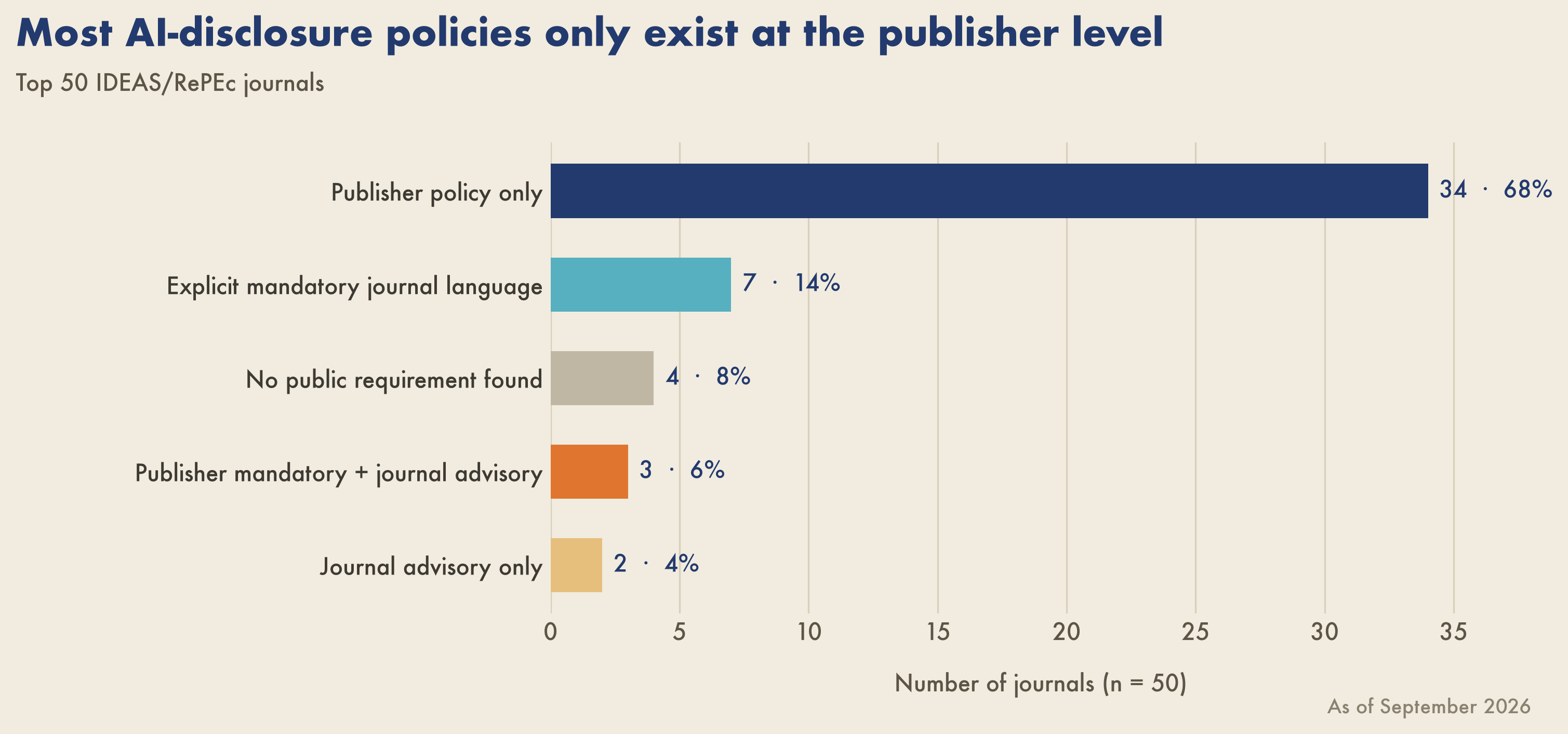
The practical result is that a disclosure requirement may exist without being prominent in a journal’s own submission instructions. That could reflect different incentives or coordination problems, but it makes things confusing for authors.
What does journal-level guidance look like? The AEA now states:
If AI software was used in the preparation of the manuscript, including drafting or editing text, this must be briefly described during the submission process
Additionally, the Journal of Labor Economics says:
When large language models (LLMs) such as ChatGPT are used to write and substantially rewrite manuscripts, this should be reported in the acknowledgment footnote.
Even these two statements draw the line differently: the AEA explicitly includes editing, while JoLE refers to writing and substantial rewriting.
Overall, there doesn’t appear to be any clear relationship between journal rank and disclosure requirements. But the prominence of publisher-level policies suggests that authors shouldn’t assume the absence of journal-specific instructions means there is no requirement. I would be very interested to hear the AEA and journal editors articulate what they hope these policies accomplish. I’m not against disclosure; I think a clearer account of its purpose would improve the broader debate.
Is research output taking off?
The dominant cultural feeling in academia is of an explosion in papers. This is particularly true when tweets like this happen:


ICLR, which is one of the largest AI conferences, has received an astonishing ~20k submissions in 2026. When we plot the growth over time (see below), we see that rapid year-over-year growth reaching sixty percent. That certainly looks like the kind of explosion people worry about in economics.
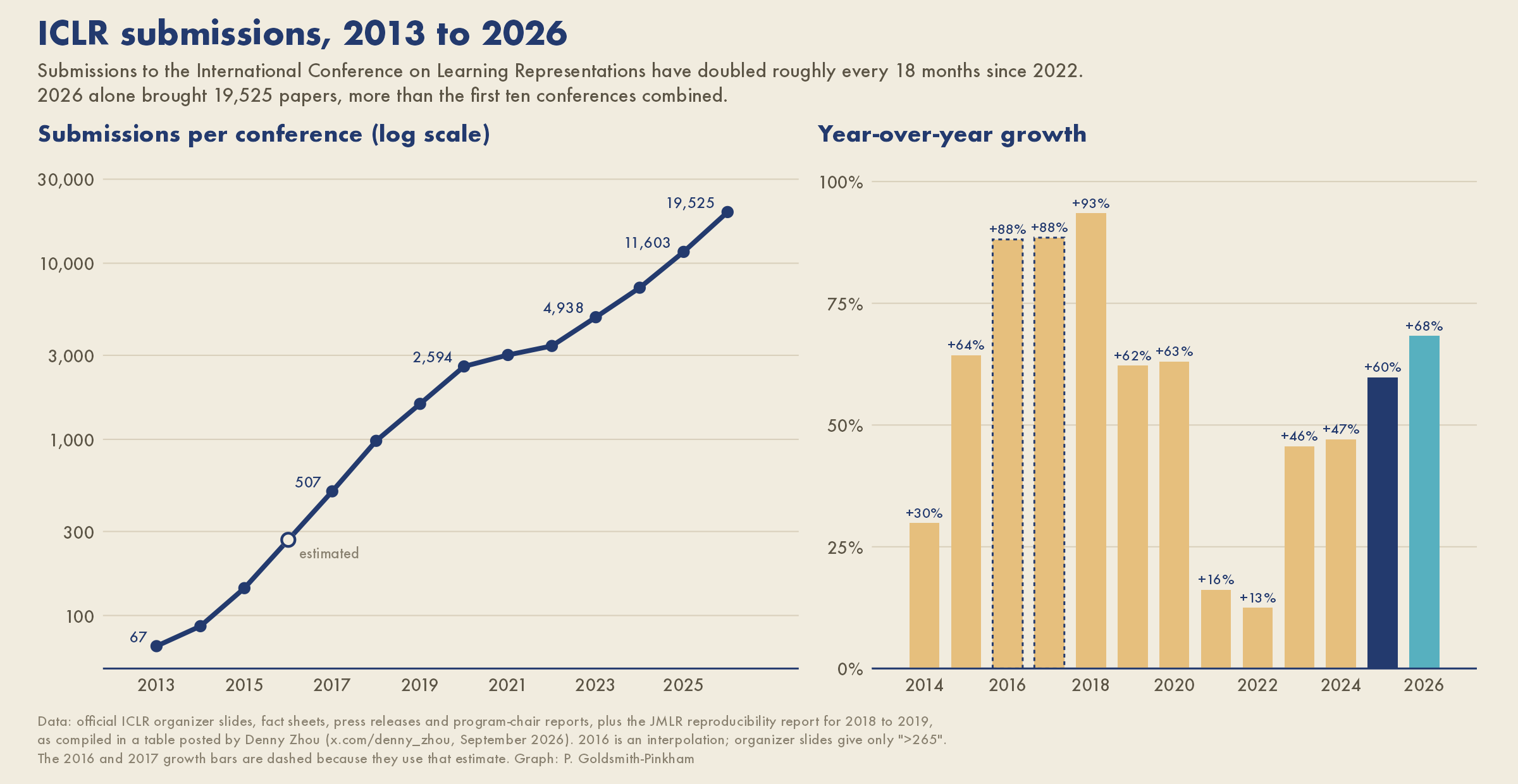
So what gives? AI researchers have both a huge new set of questions and powerful new tools to answer them. Submissions were growing rapidly well before Claude Code and Codex, though better tools may be contributing to the recent acceleration.
Does that translate to economics? We get the tools, but not necessarily the same explosion of research questions or the data to answer them. Our culture of presenting and defending research may also make it harder to submit papers the authors barely understand. In one striking account of interviews with authors of ten desk-rejected ICLR submissions, only one group answered all the interviewer’s questions; the others struggled or never completed an interview. That’s a selected sample, but it illustrates the concern.
I wonder whether we’re extrapolating from an extreme case: a field where new questions, better tools, and opportunities to submit poorly understood work may all be fueling growth. Economics may look quite different.
So what do conference submissions in economics and finance actually show?
Conferences submissions
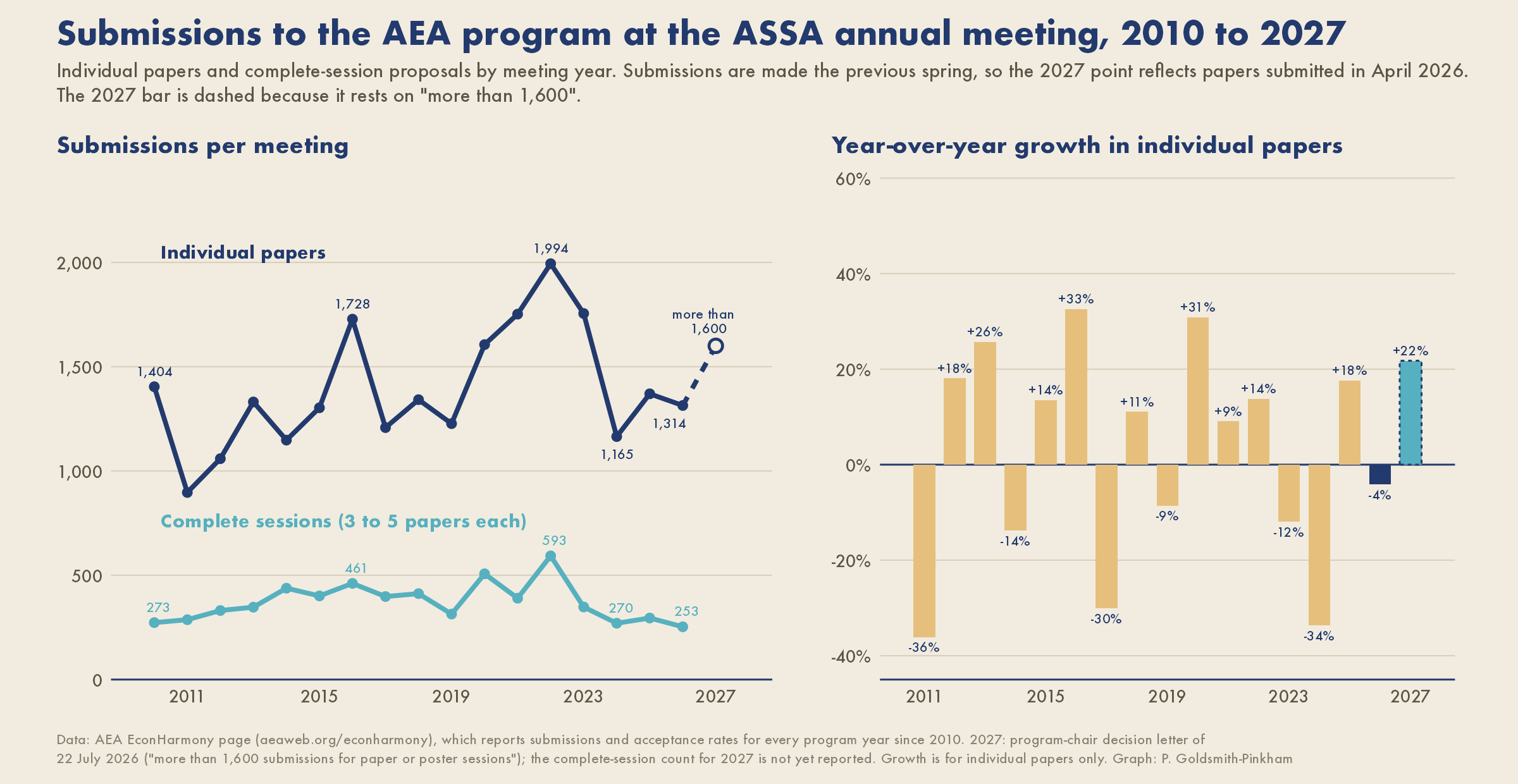
I pulled submission data for the the AEA program at the ASSA meetings. Here, submissions peaked in 2022, and are recovering toward that peak. Submissions fell in the previous cycle but have since bounced back. However, none of this variation looks abnormal relative to the historical precedent.
If you compare the year-over-year growth rate at the AEA meeting with two major finance conferences (the SFS Cavalcade and the Western Finance Association annual meeting), the recent changes also look fairly ordinary, although the historical series for the finance conferences are much shorter.
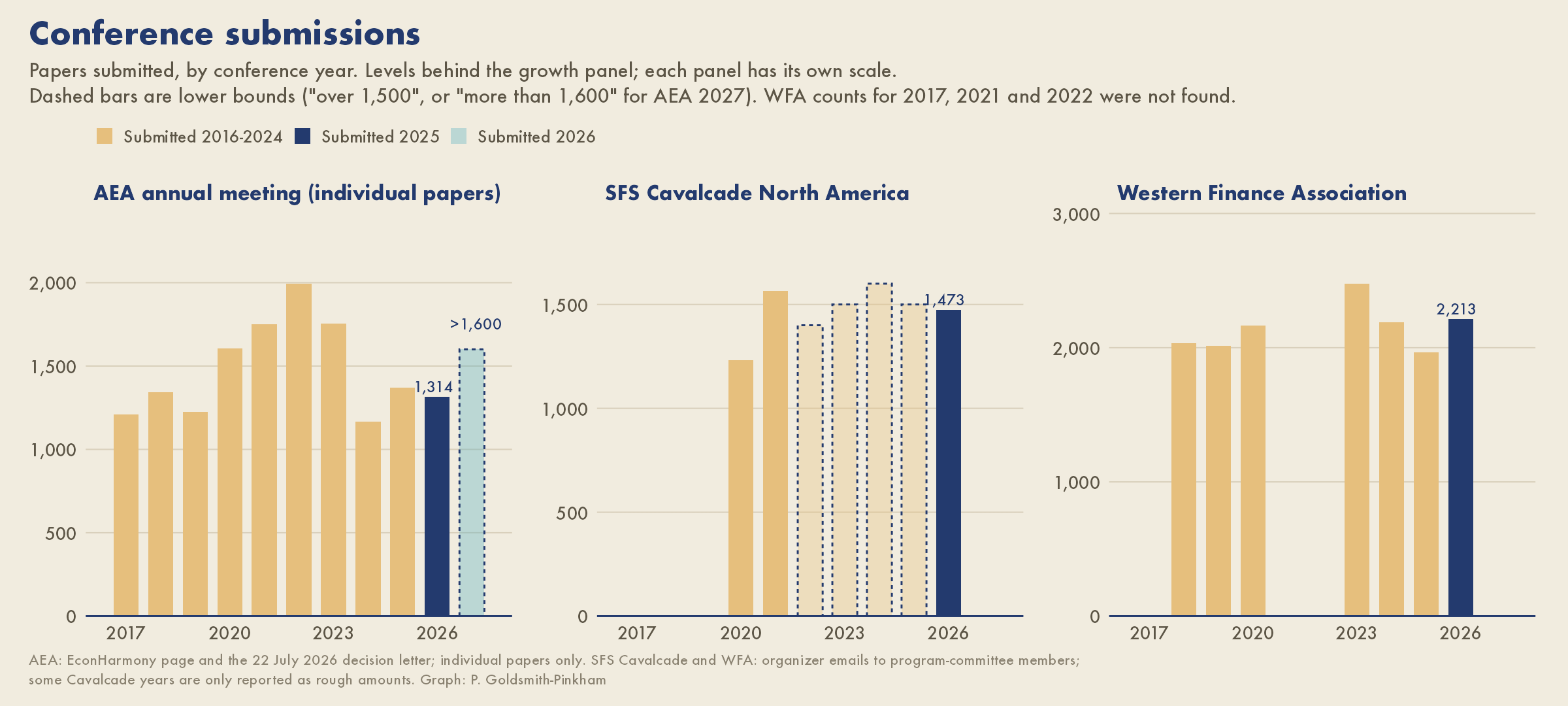
So far, the conference submission data in economics and finance look calmer than the ICLR experience. Of course, conferences play different roles across fields: in computer science, they are major publication venues; in economics, presenting a paper and publishing it are separate processes. So what do economics journal submissions look like?
Economics journal submissions
In June, following my previous post studying working papers, I asked journal editors from 16 journals to share data on submissions. All of them responded in some form or another, but not all were able to provide data. Some editors provided counts in different time series of varying lengths; others only offered general impressions, often because their publishers did not want the data shared.
The key takeaway (as of June): editors did not feel like they were being swamped by AI-generated submissions. While some editors stated submissions had gone up, they didn’t feel like there was a deluge.
Take this with a grain of salt — I have a very selected sample!
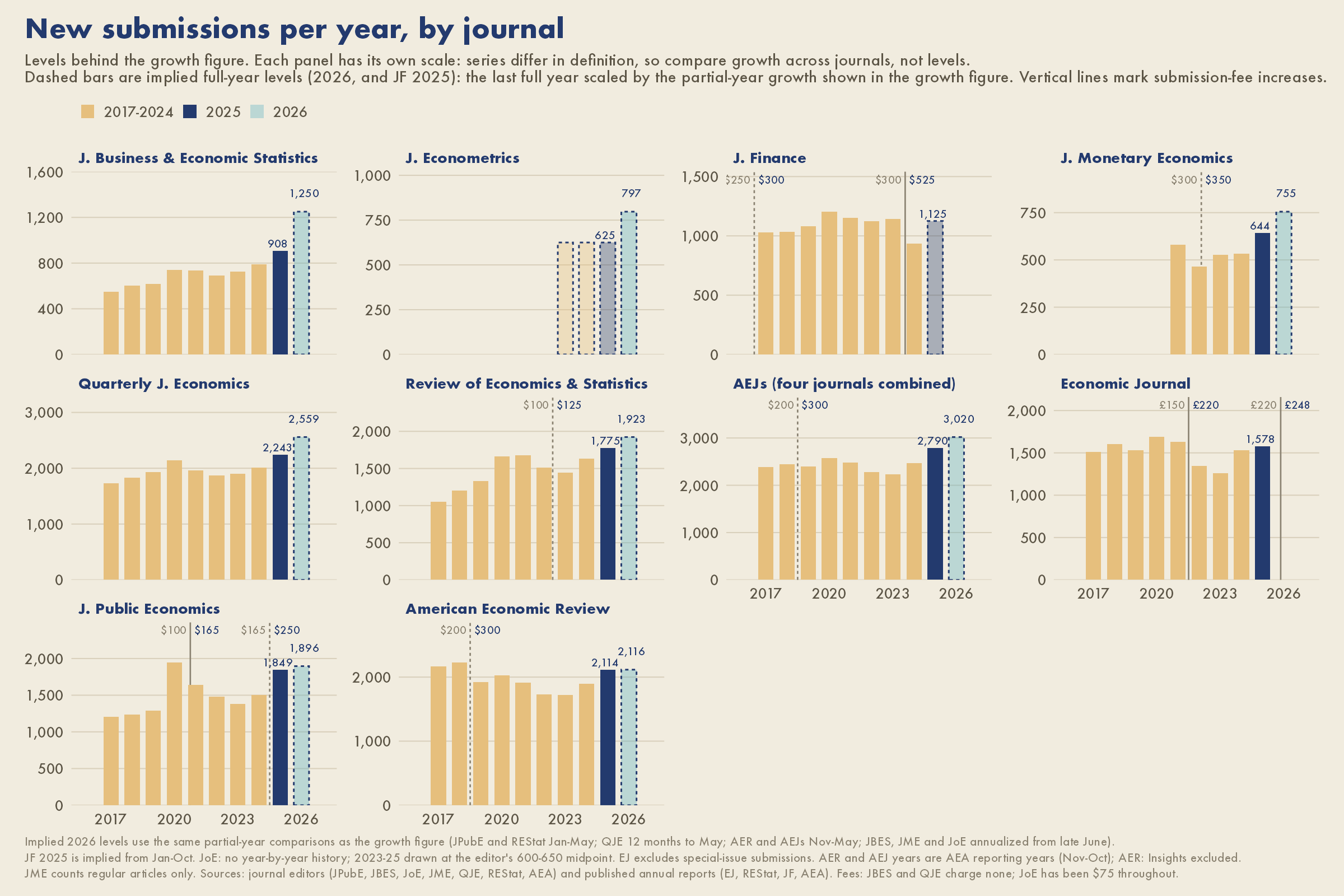
What have we seen across these journals?
An uneven picture of submission rates. At most journals, submissions were not much above their Covid-level peaks. AER submissions were essentially flat, and the AEJs saw single-digit growth over their reported comparison periods. The QJE saw faster growth, as did the Journal of Finance, JME, JBES, and the Journal of Econometrics. Some of these increases are substantial, even if they fall well short of ICLR’s recent growth.1
Several of these editors anecdotally reported that the additional submissions did not seem conspicuously AI-written. Some instead emphasized growth from outside the United States. Take this as editorial intuition, rather than hard data.
As discussed previously, journal submissions seem to respond to cost! We see that following increases in submission fees, submission growth falls. Moreover, at journals where submission fees are zero (such as the QJE and JBES) or very low (75 dollars at the Journal of Econometrics), the growth rates (and levels) are higher.
So there is growth, and at some journals quite a lot of it. But there is not yet a uniform surge across the journals in this sample. Working papers offer a somewhat different picture.
Working Papers
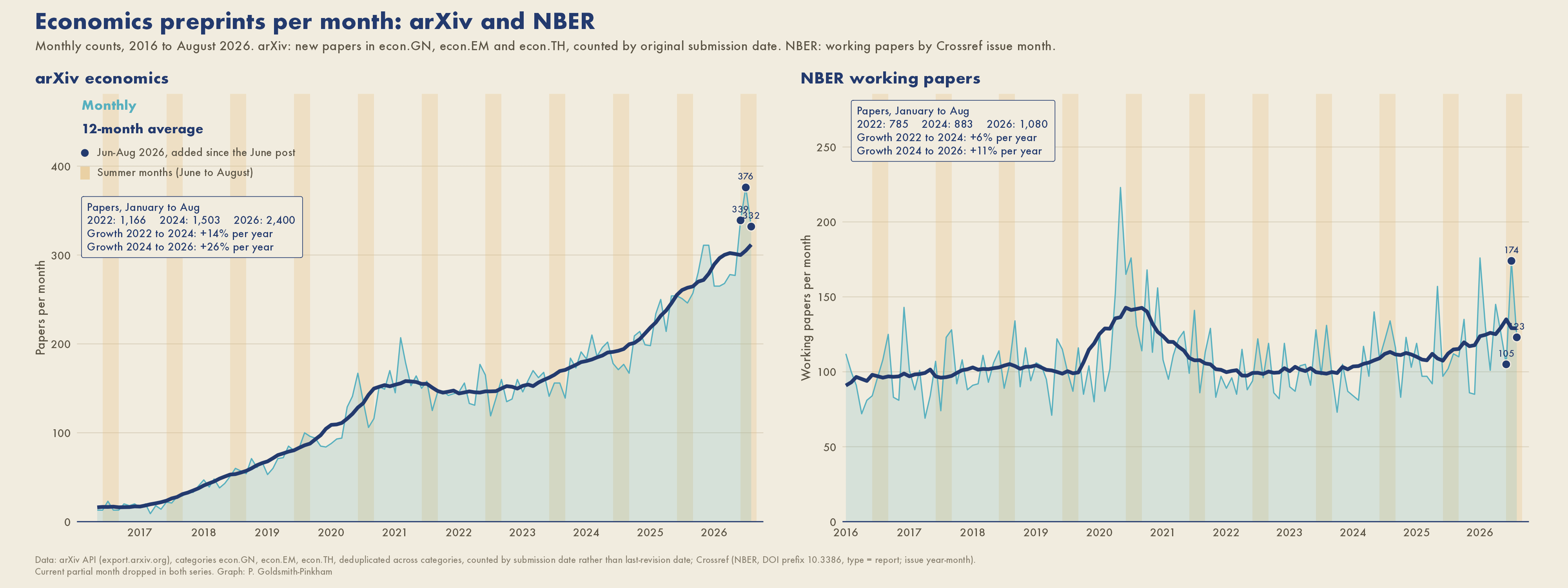
I’ve added three more months to the analysis of arXiv and NBER working paper growth above, relative to my previous post. Clearly there is growth, especially on arXiv (where we know AI usage is higher thanks to previous work). In some ways, the slower rate at the NBER is perhaps not surprising — there is a relative fixed pool of people to potentially submit, so the extensive margin is fixed, and it’s just about whether authors put out more papers.
In the figure below, we plot the paper per incumbent author for arXiv and NBER (analogous to analysis that Jimbo Brand has done for all of arXiv) and we see incumbents’ output per head jumped about 23 percent at arXiv and 18 percent at NBER between 2025 and 2026. Total January-to-August papers grew 26 and 24 percent over the same period, so incumbents likely account for most of the overall growth.
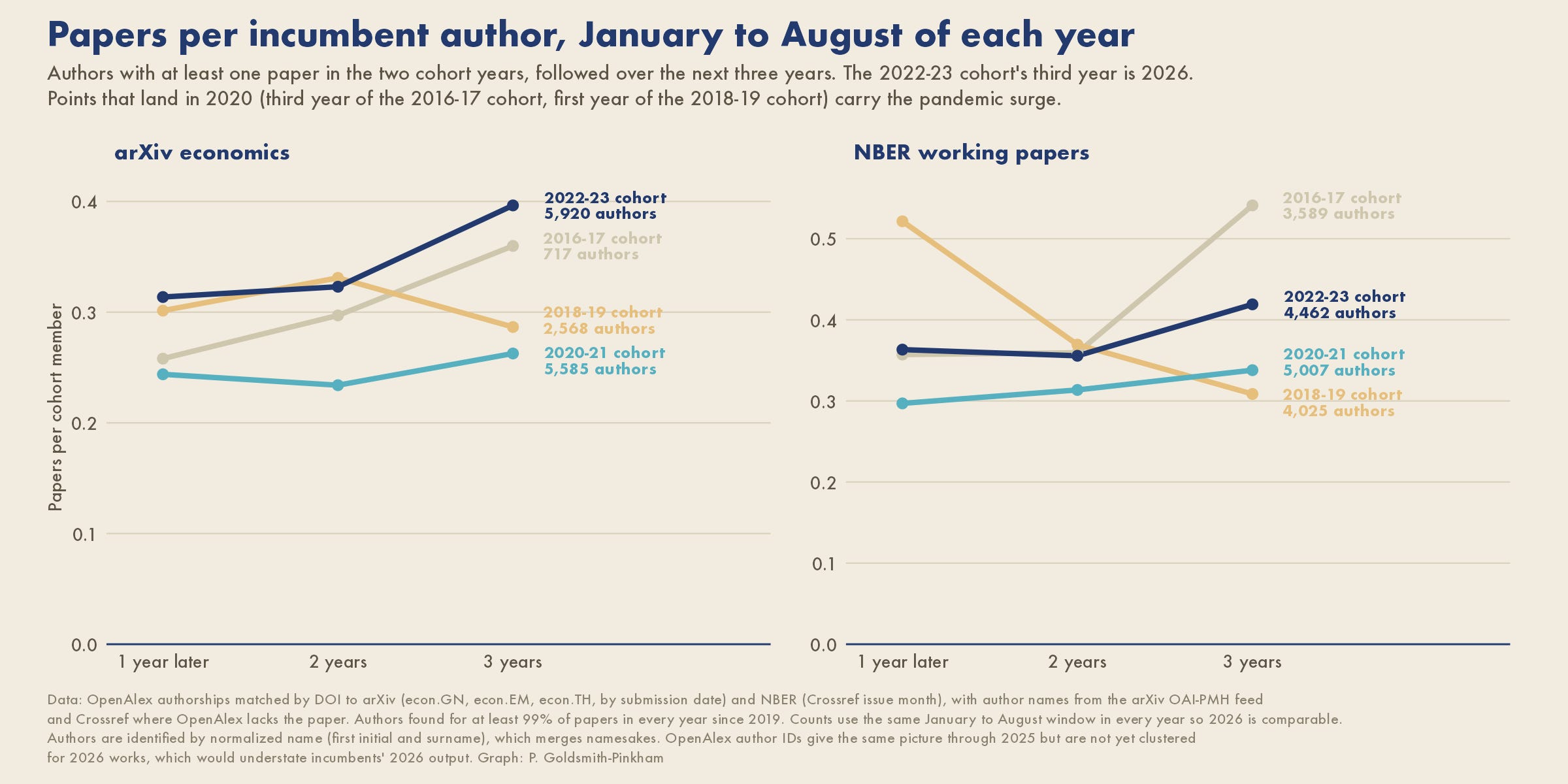
In other words — academic output is clearly growing, at least in terms of working papers. But submissions to conferences seem to be slower. How can there be this disconnect? One key feature is that in computer science, conferences and publication are tightly linked, while in economics they are separated — you could publish papers without ever attending a conference.
Where does this leave us?
AI use has spread rapidly, and working-paper output at arXiv and NBER is up roughly a quarter over last year, with substantial increases among incumbent authors. But the submission data show a much less strong picture, with little sign of an ICLR surge in economics and finance.
The question now is whether working papers are a leading indicator. Will that growth reach journals after a lag? Or will submission costs and authors’ decisions about which papers to send out keep the two moving differently?
In the spirit of AI disclosures — this post was a bit of a mess organizationally, so I broke my usual rule of using AI in writing to help clean it up a bit. Apologies if I offend anyones writing sensibilities!
The reporting windows differ across journals, and some figures translate partial-year changes into implied annual totals; the chart notes give the details.
What is your sense about the use of AI agents for research among research active economists (as opposed to free to $20/mo chatbots)?