Further Readings in Econometrics
A pilot experiment to expose empirical researchers to cutting edge econometrics
As a producer and consumer of applied econometrics, I have the view (supported by some data) that much of econometric work is under-appreciated and under-consumed by applied folks. I think this is not applied folks fault — there is a broad concern that econometric theory is very technical and perhaps distant from applied research. I am not alone in this! For example, Chuck Manski in his Econometric Theory interview:
I worry enormously about the amount of effort that econometric theorists put into more and more obscure forms of local asymptotic theory. It used to be that you did it with at least some hint of an application, but now you can do it without having anything in mind except the most toy application. I take a very strong position on this, that a lot of this is mathematics for the sake of doing mathematics. I think it is dangerous for econometrics as a field.
I think there needs to be some encouragement and translation to help rectify this. There is already a burgeoning amount of interesting applied econometrics work done by wonderful researchers (too many to name, but including Kevin Chen, Jonathan Roth, Michal Kolesár, Peter Hull, Ashesh Rambachan, Mikkel Plagborg-Møller, Davide Viviano, Isaiah Andrews, Soonwoo Kwon and many others). Some of these papers have seen significant take-up and interest, often because they are targeted at applied researchers.
The Journal of Economic Perspectives (JEP) produces a wonderful column that suggests interesting papers and columns to read. That column:
will list readings that may be especially useful to teachers of undergraduate economics, as well as other articles that are of broader cultural interest.
So: this column will attempt to list econometrics papers and readings that may be useful to applied researchers in economics and finance. Since often it is not clear why these papers are useful, I will attempt to also give a brief explanation as to why and how to consider it.1
Some ground rules:2
I will look at econometrics articles published in Econometrica, American Economic Review, Quantitative Economics, Review of Economics and Statistics, Journal of Business & Economic Statistics, JASA, and Journal of Econometrics in the last year (probably the last quarter, but giving myself some flexibility).3
I will focus on papers where there is an immediate insight useful for practitioners.
I will propose an example empirical setting where I think this might be relevant — bonus points if I can point to an existing research paper where I think they should’ve used the method.
I won’t write more than 2 paragraphs per article.
I will write about at least 5 papers per column
I will write this once a quarter (it’s July now, so next one in October).
Ok, here goes nothing. If you like this, let me know. If you hate it, let me know too.
Further Reading in Econometrics for Applied Researchers, Vol. 1 (Aug 2026)
Factorial Difference-in-Differences
Yiqing Xu, Anqi Zhao, Peng Ding, JASA
https://doi.org/10.1080/01621459.2026.2628343 (wp version: https://arxiv.org/abs/2407.11937)
When we’re thinking about difference-in-differences, we lump together many different types of designs. The most canonical design is a setting where we have a policy that gets applied in a post-period to a set of treated firms, but the treated firms are non-randomly selected, hence identification challenges. But, another very common design is a setting where units look different in a static sense (perhaps they are counties with different housing supply elasticities), and we postulate that an aggregate shock differentially affects these places.
Turns out that this latter approach is not obviously identical to standard difference-in-difference, once you think carefully about it as a treatment. Xu et al. (2026) term this “factorial difference-in-differences” (which I think is a terrible name, but ¯\(ツ)/¯). It turns out that for this design to identify the causal effect of the baseline differences (e.g. the housing supply elasticity) using this design, you need an additional assumption that assumes mean independence between the baseline differences and the potential outcomes.4 Fortunately, I believe this assumption is quite similar to what researchers typically believe when they invoke this approach.
Key takeaway for empirical researchers: you need to justify your assumptions more explicitly here, and highlight that potential outcomes in the absence of the aggregate shock need to be mean-independent of the characteristic.
The Effect of Omitted Variables on the Sign of Regression Coefficients
Matthew A. Masten, Alexandre Poirier
American Economic Review 116(7) — 2026-06-30
https://doi.org/10.1257/aer.20230242 · open access
Oster (2019, JBES) is an incredibly influential paper5 that expands and synthesizes the intuition from Altonji, Elder and Taber (2005) about how to try to bound the effect of unobservables. We all know that if you have omitted variables, your estimate can be biased. Often, we add additional controls and show that as we add more controls, our estimates of interest are “stable” (e.g. don’t change across specifications). Oster (2019) provided conditions and a test for how to think about this approach, and a formal test that exploits the changes in the coefficient measure and the R2 to study how much omitted variable biasthere would need to be to drive the true effect to zero.
Masten and Poirier (2026, AER) is a sharp critique of this approach. Oster (2019)’s test (δ) measures how much selection on unobservables takes to drive the coefficient to zero, but that’s different from how much it would take to flip its sign. It turns out these can be very different. Since the δ test is a ratio of coefficients, the bias-adjusted estimate is discontinuous in δ and can jump across zero rather than passing through it. The key takeaway is to consider the “sign-change” breakdown point alongside the Oster (2019) measure. All of it is implemented in the regsensitivity Stata package.6
Key takeaway for empirical researchers: when justifying your design based on the stability of coefficient estimates, you have another important test to run and interpret.
Double Robustness of Local Projections and Some Unpleasant VARithmetic
José Luis Montiel Olea, Mikkel Plagborg‐Møller, Eric Qian, Christian K. Wolf
Econometrica 94(4), 1313–1343 — 2026-07-16
https://doi.org/10.3982/ECTA23345 · open access
VAR (Vector Autoregressions) and LP (local projections) are a lynchpin of macro analysis. If you’re more of a micro person, you probably only remember VARs from your first year macro courses. One way to think about LP is that it’s semi-parametric in the dynamics of how shocks propagate, while VARs are very structured and parametric in their propagation mechanism. Both LP and VAR consider the structural model, but they differ in how they propagate the shock forward. E.g. imagine you want to study the impact h periods ahead. Here’s the two processes written down:
It turns out when the first model (VAR) is correctly specified, there’s a direct mapping between LP and VAR such that they’re equivalent! E.g. LP is the reduced form version of the VAR model. LP does not restrict how the propagation maps forward. But if the VAR is misspecified, the VAR does very badly. In Olea et al. (2026), they show that if the VAR is misspecified, the confidence intervals are wrong. However, the local projection approach will have the right coverage rates, even under misspecification!
Key takeaway for empirical researchers: Applied researchers should prefer LP for robust inference unless they are willing to use extremely long lags that render the VAR interval as wide as the LP interval.
Optimal Shrinkage Estimation of Fixed Effects in Linear Panel Data Models
Soonwoo Kwon, Econometrica — 2026
https://doi.org/10.3982/ecta22386 (wp version: https://arxiv.org/abs/2308.12485)
Empirical Bayes When Estimation Precision Predicts Parameters
Jiafeng Chen, Econometrica — 2026
https://doi.org/10.3982/ECTA22935 (wp version: https://arxiv.org/abs/2212.14444)
Fixed effects have historically been nuisance parameters for estimation (e.g. when we include unit and time fixed effects, we are not interested in those parameters). However, now a lot of applied work in economics and finance tries to directly estimate unit-level effects and then doing something with them: teacher value-added, judge leniency, hospital quality, neighborhood effects, or manager or fund-manager alphas.7 The challenge is that these estimates are very noisy, typically, with a limited number of observations. So how do we improve on the estimation?
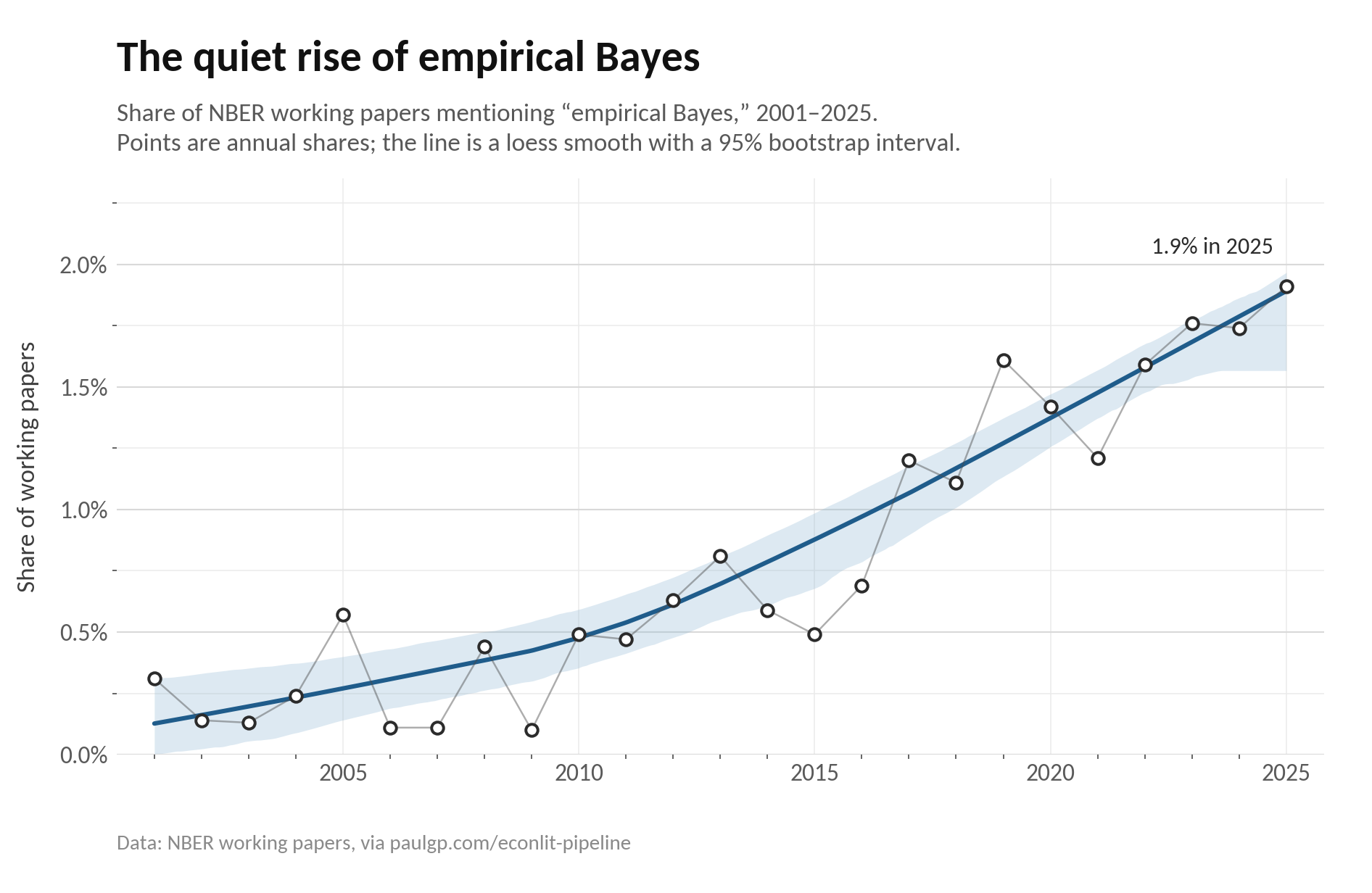
The typical approach is empirical Bayes (canonically inspired by Morris (1982), and used to great effect by Chetty, Friedman, and Rockoff (2014) and Chetty and Hendren (2018), as well as many other papers. Basically (Bayes-ically?), since the raw OLS fixed effects are noisy, we shrink them towards the overall mean as a function of the noisiness of the raw estimates. The challenge is that parametric empirical Bayes rests on normality of the true effects, normality of the least squares estimator, and, the key focus of Chen (2026), independence between the true effect and the variance of its estimator (referred to as precision dependence). This last estimate is empirically implausible: class size is mechanically linked to the precision of the estimate and is plausibly correlated with teacher skill due to assignment, so the two are linked by construction. To solve this issue, Chen (2026) stays inside empirical Bayes and makes the prior richer by modeling the conditional distribution of the parameter.
Kwon (2026) also delivers robustness to precision dependence, but that is a byproduct of the approach. Kwon (2026) instead focuses on the fact that the object you have is usually not one number per unit but several, such as a teacher’s value-added in each of six years, or her effect on test scores and on graduation. Existing practice either averages across years, imposing that the effect never moves, or shrinks each year in isolation, ignoring that a teacher’s good year predicts her other good years and over-shrinking as a result. Kwon (2026) extends existing unbiased-risk-estimate results to the case where the tuning parameter is a full covariance matrix, so the rule shrinks linear combinations differentially, which creates a smoothed time profile, rather than a flat one. This allows for a one-period-ahead forecast of the effect, which is useful for a retention or promotion decision for a teacher.
The cleanest way to see the contrast is as a trade-off between random-effects and fixed-effects. Chen (2026) is the analogy to correlated random effects, whereby specifying a distribution correctly for the heterogeneity, you are rewarded with a rule that can be nonlinear and that uses the information precision fully. Kwon (2026) is the analogy to fixed-effects: nothing about the distribution of effects is modeled, so nothing there can be misspecified, but the price is that you need to pre-specify a class of (linear) decision rules, and optimality is only ever relative to that class.
Key takeaway for empirical researchers: the real choice is whether you would rather model the distribution of your unit effects or the class of rules you will consider for shrinkage. If you have one effect per unit and you model the prior, Chen’s framework is potentially more flexible and powerful if the model is specified correctly. If your effects vary over time or across outcomes, or you want a forecast, Kwon applies more directly and asks less of you distributionally. Either way, straight empirical Bayes is no longer an easily defensible default.
R Package for Chen (2026), R Package for Kwon (2026)
As a companion, I would love to write a column that also lists interesting applied papers with unusual data / settings that should be of interest to econometricians. If you’re interested in helping me with that, let me know!
Inspired by Ben Recht ‘s ground rules for blogging
I maintain the right to expand this list
As it turns out, this is a very similar assumption to the one necessary to identify the continuous DiD estimator (strong parallel trends) highlighted in Callaway, Goodman-Bacon, and Sant’anna (2025).
My understanding is that this paper took a long time to get published, so it has been influential for a long time, despite only arrive in final print in 2019.
Curious if anyone has written an R package for this? If not, someone should consider doing this! I know it’s feasible, because a former grad student Dana Scott wrote it up once for us on a project, but it would be nice to have as a package.
I’m not sure if finance people think about it this way but it’s in the same group!
Thank you for this new Substack. This is a great idea. And best wishes!
I haven’t read the whole column yet, but let me say that I think this effort is extremely useful. Let me tell you my story.
Earlier in my career I tried to exploit my knowledge of econometrics data science and statistics to do applied work. My statistical education went a bit beyond the standard econometrics core —I took classes in predictive modeling and Bayesian statistics with the stat folks. In the stats departament the focus was really applied, so my hope was that I would likely be able to apply those techniques to new problems.
Now, when I came back to the econ world I found that The applied people were hostile to any innovation that was not implemented smoothly in Stata (“why do you partially pool your fixed effects in a hierarchical model? This is very unconventional” “what’s the point of this Gaussian process? Just do OLS”). Nobody wants to ready the methodological section of your paper.
My hope was that I would be more successful if I shopped among the econometrics people. After all, econometrics is supposed to be about developing methods that are ready to use for economic questions, so probably my applied peers would be more receptive to these. However, attending econometric sessions in conferences was much worse: there was exactly zero focus on explaining why this was useful to solve this or that particular problem, it was all about relaxing this or that particular assumption. It seemed written for other econometricians, never with the users of those techniques in mind. So, the hope to use one these new estimators to do produce a new paper seems hopeless.
A related problem is implementation: even if they show that their estimator are useful, econometrics people rarely any software that can be used by applied researchers. This is not surprising as this is a lot of work and hard to maintain, probably not sufficiently recognized within the Econ world. Consider the big contrast with the work that Gelman and his coauthors have done with the Stan environment for Bayesian statistics.
In that respect, I think the work of new DID literature should be the standard: taking a problem in applied research, showing that the standard method delivers bad results, and underscoring how your new estimator does better; they also have developed great if R packages and tutorials and have a webpage for it.
With that backup, it is much easier to people like me to use such estimators in applied research